Chapter 4 Rekt: Token Price Collapse and Full Conversion Risk
This chapter is a collection of case studies on how I got rekt as a concentrated liquidity provider. I ate shit so you don’t have to. But even after reading my blunders, there’s a good chance you’ll fall into the same trap–chasing fee income while ignoring the risk of ruin when token prices collapse. Keep that in mind and revisit this chapter often, especially before deploying capital into a new pool.
In chapter 2, we saw that an AMM pool continuously buys the depreciating asset and sells the appreciating one. Combined with the highly reflexive nature of crypto prices, this makes it dangerously easy for LPs to lose money.
⚠️ Getting Rekt
LPs get rekt if either token in the pair crashes and never recovers.
As the underperforming token declines, the AMM automatically sells the stronger token in your position to accumulate more of the crashing one, dragging down the dollar value of your position. In a concentrated liquidity position, this effect is amplified. Once the price falls below your lower bound, your position undergoes full conversion: it becomes 100% the crashed token, falls completely out of range, and stops earning fees. At that point, breaking even is nearly impossible without a price recovery.
In a full-range position, full conversion doesn’t technically occur, but you are not safe either. Your liquidity is spread from negative infinity to positive infinity, so it earns fees at a much lower rate. On top of that, falling prices are usually accompanied by lower trading volume, which further reduces fee income–making it just as hard to recover losses without a rebound.
Because fee income rarely outpaces heavy capital losses–and because most crypto tokens eventually go to zero–LPs must be extremely selective about the pairs they choose. Before deploying capital, look past short-term market frenzy and inflated APRs29 and ask yourself:
- Will this coin still be around in ten years? Most won’t.
- How likely is it to crash in the next three to six months?
- If it crashes, can it bounce back–or is that the end?
These questions don’t always have obvious answers. But making a habit of asking them will drastically reduce your chances of getting rekt.
4.1 Rekt by Shitcoin
Amateur LPs are often drawn to pools advertising triple- or even four-digit APRs, without considering the quality of the underlying assets. Most of these high-yield pools pair a solid coin with a shitcoin that’s temporarily hot. When the shitcoin collapses, panic selling kicks in, the price spirals down and rarely recovers–and you’re left holding 100% of the wreckage.
If you’re new to crypto, you likely don’t know how to evaluate a token beyond its price and will mistake a shitcoin for a good one. One evening in July 2021, I was making dinner while listening to TechLead, a YouTuber with a large following, shilling Million Token (ticker: MM). Although I had previously bought and sold BTC and ETH on Coinbase, I had never gone deep into the crypto industry and didn’t realize it was in a speculative phase–DeFi was booming, NFTs were taking off, and influencers were pumping and dumping worthless coins. Enticed by MM’s rapid price surge after launch, I installed Coinbase Wallet, withdrew ETH, and swapped it on Uniswap for roughly $3,400 worth of MM.
I paid steep gas fees, but the next day my MM position doubled in value. I thought about selling but didn’t–I was greedy and wanted more upside30. Then I heard people were earning four-digit APRs by providing liquidity to the MM–WETH v3 pool on Uniswap. Naively, I thought I could earn fees while waiting for the price to go higher, so I jumped in and opened my first concentrated liquidity position.
The timeline below summarizes how it unfolded:
- Day 0: Bought 37 MM at $92 each.
- Day 1: Price doubled. I had never seen anything like it and decided to hold out for 3x.
- Day 2: Price dropped. I opened a Uniswap v3 CLP position with 10 MM and 0.5 ETH at prices of $157 and $1,913, respectively.
The position earned $68.57 in the first 26 hours, but its ETH portion was aggressively sold for MM as it got cheaper and cheaper. Like a rocket that ran out of fuel, MM kept dropping–through the lower bound of my price range, into double digits, then single digits, and eventually below $1. By the time I pulled liquidity, I had lost $2,300 from MM’s collapse. The fees earned didn’t even cover the gas, let alone the capital loss!

4.2 Rekt by Altcoin
I broadly classify cryptocurrencies into four categories: Bitcoin, stablecoins, altcoins, and shitcoins. Bitcoin is the king, commanding the largest market capitalization ($1.25T as of July 5, 2026). The table below compares the top ten cryptocurrencies by market cap during the 2017-2018 alt season31 with those today.
| Rank | 2017-2018 Alt Season | July 5, 2026 |
|---|---|---|
| 1 | Bitcoin | Bitcoin |
| 2 | XRP | Ethereum |
| 3 | TRON | USDT |
| 4 | Zcash | BNB |
| 5 | Cardano | USDC |
| 6 | Stellar | XRP |
| 7 | Monero | Solana |
| 8 | Bitcoin Cash | TRON |
| 9 | Litecoin | Hyperliquid |
| 10 | Ethereum Classic | Dogecoin |
The comparison is telling: Bitcoin is never dethroned, but altcoins constantly turn over. Today’s blue-chip altcoin can fade, and in some cases, go to zero.
4.2.1 LUNA, The Failed Blue-Chip
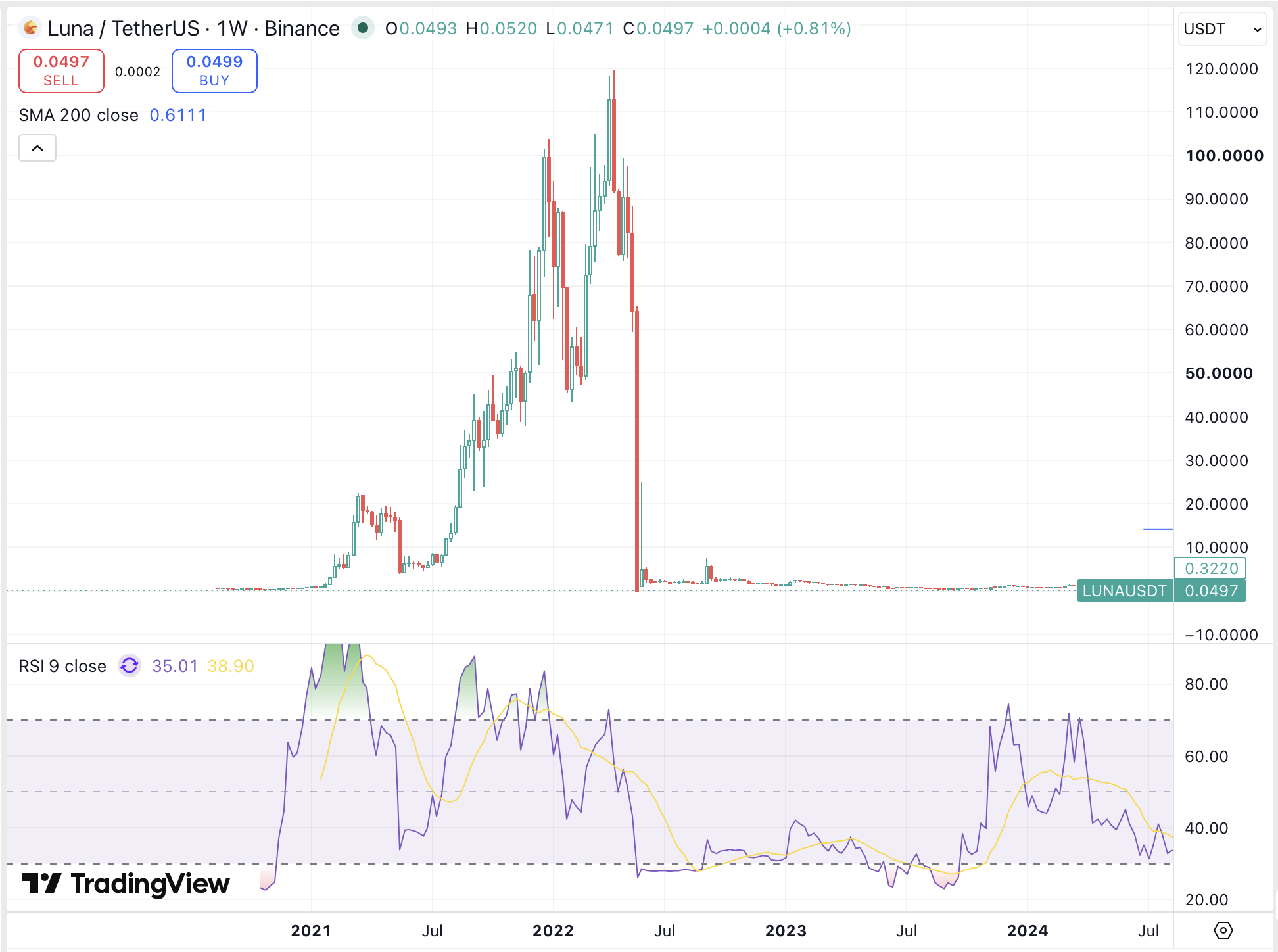
LUNA was the native token of the Terra blockchain, launched in April 2019. It began trading below $0.50 and surged to $119.55 by April 5, 2022. In just three years, LUNA became the 8th largest cryptocurrency, reaching a market cap of nearly $40 billion. Terra’s decentralized stablecoin, UST, also grew rapidly, peaking at around $18 billion and becoming the third-largest stablecoin at the time, behind USDT and USDC.
In May 2022, everything unraveled. UST depegged, and LUNA collapsed. Within a week, nearly $45 billion in market value was wiped out.
I’ll let you research the LUNA fiasco yourself. Start with this article from the Richmond Fed and this [Wikipedia entry on Terra](https://en.wikipedia.org/wiki/Terra_(blockchain\)). Afterwards, feel free to ask perplexity.ai more questions.
💡 Example questions to ask perplexity.ai
- What’s the timeline of UST/LUNA fiasco?
- What are the details of the 2021 UST peg defense incident?
- What role did Jump Trading and Three Arrows Capital play in the rise and fall of UST and LUNA?
Like many others, I drank the Kool-Aid and hoped I could retire on LUNA and UST, only to lose every penny I had put in. In hindsight, it was obviously foolish, but at the time it was hard to resist the lure of fast money. When you could earn a “risk-free” fixed yield of 19.5% by lending UST on Anchor, a money market built on the Terra blockchain, while LUNA kept climbing to new highs, greed made it easy to chase that “free money” for as long as possible. The music hadn’t stopped, so you kept dancing.
That frenzy spread through the LUNA community, which was full of sharp, analytical minds, many of whom were convinced that LUNA would hit $200. FOMO hijacked your brain, and taking profits felt almost unnatural. Instead, people looked for ways to accumulate more LUNA as the price rose.
One of those ways was LPing. There were no DEXs in the Terra ecosystem that offered concentrated liquidity pools, but full-range LUNA/UST pools on Terraswap and Astroport often yielded more than 20%, and sometimes as much as 150%. I used these pools to accumulate LUNA.
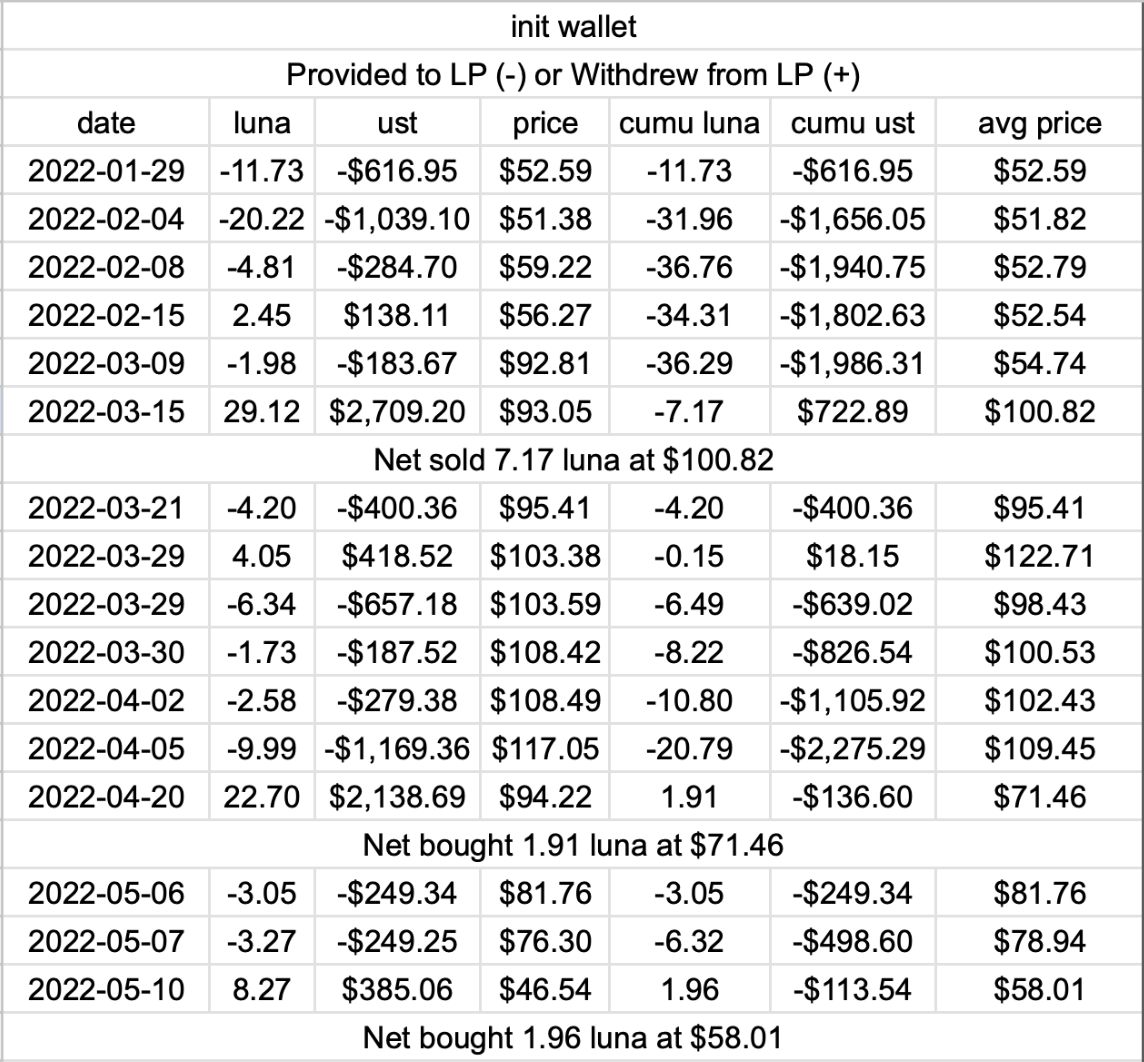
Then came the collapse. As LUNA’s price crashed, those LP positions left me holding a pile of LUNA that had been hard to acquire just days before. Gripped by loss aversion, I refused to sell and kept buying more LUNA and UST, hoping they would rebound as they had in a prior depeg-repeg event. They never did.
4.2.2 ETH, The Largest Altcoin
After LUNA and UST blew up, I shifted to providing liquidity in what felt like the safest pair: BTC-ETH. BTC and ETH seemed much safer not only because they were the largest crypto assets and had stood the test of time32, but also because history appeared to offer a clear pattern. In the 2017–18 and 2020–21 alt seasons, BTC pumped first and ETH followed with even greater gains. If history were to rhyme, a BTC-ETH LP position would eventually sell the ETH portion back into BTC, the stronger asset.
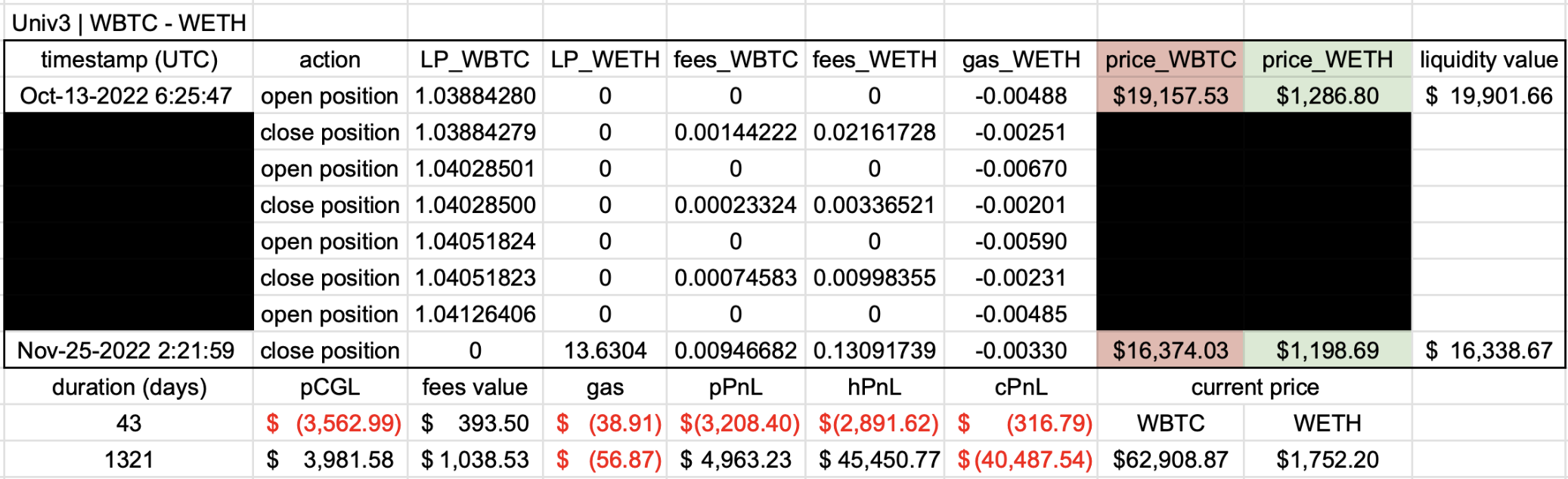
Between October and November 2022, I sent a little over 1 BTC into a WBTC–WETH33 Uniswap v3 pool on Ethereum, opening and closing four single-sided positions in succession. For the first three positions, ETHBTC34 made a round trip, so I recovered 100% of the BTC I had provided, plus some fees–basically collecting a yield on BTC without giving up any BTC. On the fourth position, ETHBTC fell below my lower bound. Rather than wait for it to move back up in range, I closed the position and withdrew ETH, which had been converted from the BTC I provided. My capital loss was $3,563, I earned $394 in fees, and I spent $39 on gas, for a total PnL of -$3,208. Had I simply held the BTC instead of LPing it, I would have lost $317 less.
 At the time, the consensus was that ETHBTC would revisit its all-time high in
2023 and perhaps even set a new one, so the playbook seemed straightforward:
At the time, the consensus was that ETHBTC would revisit its all-time high in
2023 and perhaps even set a new one, so the playbook seemed straightforward:
- DCA out of BTC into ETH via LP while earning some yield.
- Use the ETH for airdrop farming and yield strategies.
- DCA back out of ETH into BTC via LP once ETHBTC makes a new high.
I completed steps 1 and 2, but step 3 never materialized because ETHBTC never reclaimed its all-time high. Since its last major local top on 8 September 2022, between 0.085 and 0.0935, it has trended down ever since.
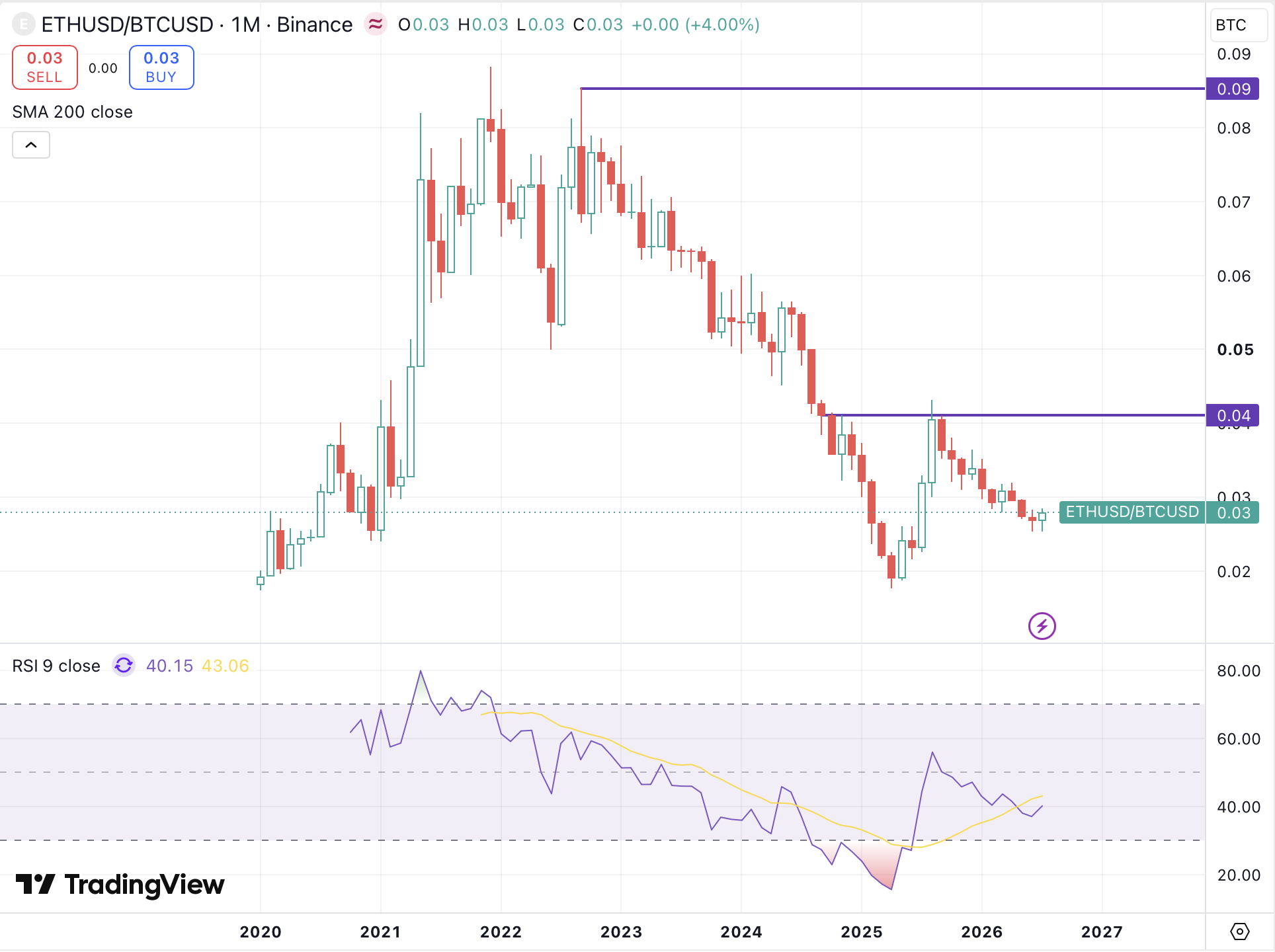
At the time of writing, 1,321 days after I paper-handed BTC for ETH via LP, ETHBTC is trading near 0.03 and airdrop farming is largely dead. At current prices, I would be ahead by roughly $40.5K had I simply held the BTC. True, I did use the converted ETH for airdrop and yield farming and earned about $60K in airdrops, which put me ahead by about $20K overall. But that income was far from passive: I spent hours clicking buttons and took on significant smart contract risk. Net to net, and on a risk-adjusted basis, simply holding BTC would have been the better choice.
4.2.3 STG, The Slow-Bleed Farm Token
A major subcategory of altcoins is DeFi farm tokens, the tokens of individual DeFi applications. They are called farm tokens because they are meant to be farmed and dumped, not held for the long term. These tokens face constant sell pressure from inflationary emissions, token unlocks, or both. At the same time, they often fail to accrue value, either because the platform does not generate enough growth or meaningful revenue, or because it does not share any revenue with token holders. As a result, demand stays weak, supply overwhelms demand, and the token price eventually trends to zero.
That makes ETH or SOL far better long-term assets to own than most ETH- or Solana-based DeFi tokens. But during certain phases of the market cycle, some farm tokens can outperform ETH or SOL by a wide margin. At those times, the juicy fees from AMM pools pairing these tokens with ETH or SOL become hard to resist. People forget the long-term fate of the farm tokens, add liquidity, and get rekt.
One such farm token is STG, the governance token of Stargate, a bridge that lets users move coins across multiple blockchains. Built on LayerZero36, Stargate has established itself as a secure, unified liquidity layer for fast, low-fee transfers across many chains. Whenever I need to bridge a coin, I check Stargate first, and I use it for most of my bridging. It solves a real problem and clearly has product-market fit, but STG has been trading poorly.
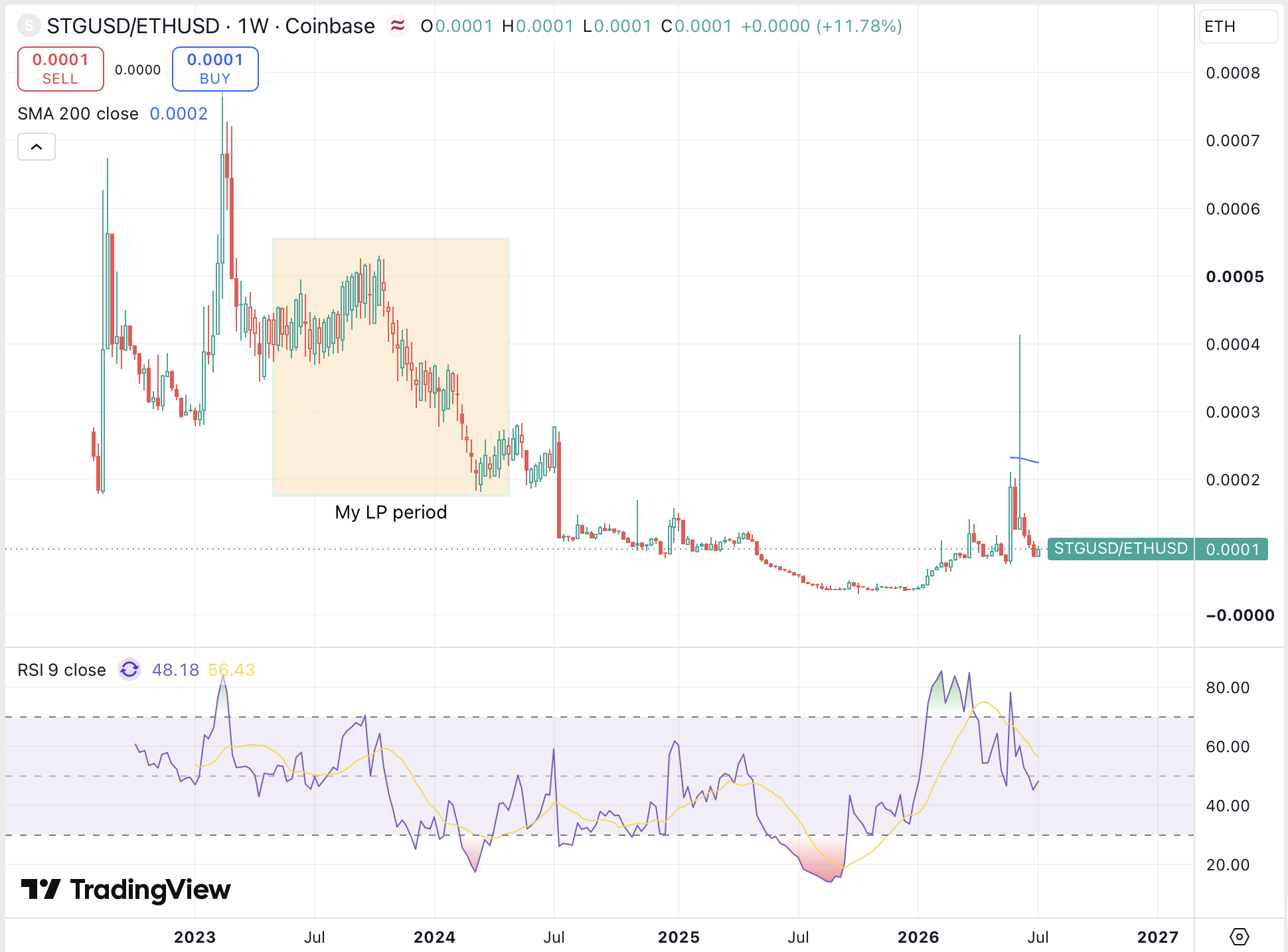
After making its all-time high between February 16 and 18, 2023, STGETH37 quickly retraced most of that move and spent seven months, from March 8 to October 19, 2023, forming a base and attempting to break out to the upside as people bought and staked STG in hopes of a future LayerZero airdrop.
Tempted by the juicy yield and comforted by the potential LayerZero airdrop, I deposited a total of 5.4 ETH into narrow STG-WETH Uniswap v3 ranges on Arbitrum, even though I did not want to own STG. Over three months, I earned 1.0488 ETH and 1,570 USDC38 in fees, but ended up with a heavy bag of STG after STGETH fell below my lower bounds.
Instead of dumping it immediately, I was taken hostage by loss aversion39. Selling would have meant realizing the loss, so I staked the STG for the potential LayerZero airdrop while secretly hoping for a scam pump to give me an exit. That pump did come when STG was listed on Upbit, but by then my STG was still staked, so I could not sell. I eventually sold the bag for only 3,206 USDC.
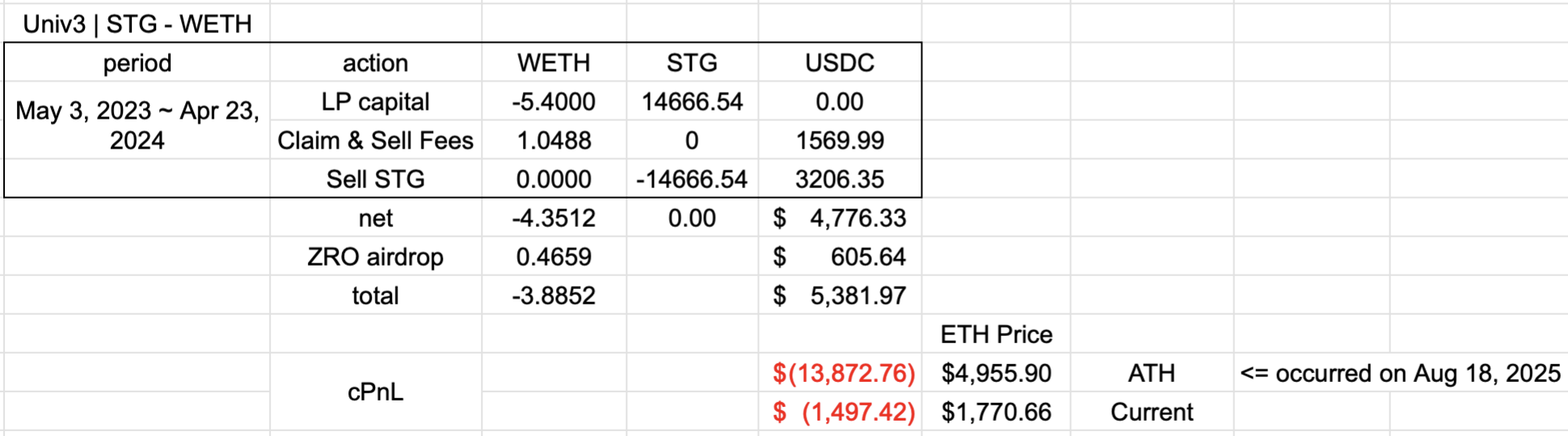
After the dust settled, my STG-WETH LP effort had effectively amounted to selling 4.3512 ETH for 4,776 USDC. I did receive the LayerZero airdrop and sold it for 0.4659 ETH and 606 USDC. The total result was effectively selling 3.8852 ETH for 5,382 USDC.
Had I held the 3.8852 ETH and sold at its all-time high on 18 August 2025, I would have made $13,873 more. Even if I had held until today, with ETH at $1,771, I would still have made $1,497 more.
4.3 Rekt by Depegging
Astute readers may have noticed that all the rekt examples so far involved pairs whose relative price could move freely between zero and infinity. This may lead you to believe that stable pairs are safe.
💡 Stable Pair
A stable pair is a pair of tokens whose relative price follows a straight-line relationship as a result of the underlying token design.
Common stable pairs include:
- Two different stablecoins, for example, USDC-USDT.
- Two different wrapped representations of the same coin, for example, WBTC-cbBTC.
- An LSD40 and its native token, for example, stETH-ETH or jitoSOL-SOL.
- Two different LSDs of the same native token, for example, stETH-rETH or jitoSOL-jupSOL.
If both tokens track the same price–for example, USDT and USDC, or WBTC and cbBTC–their price ratio should fluctuate tightly around 1.
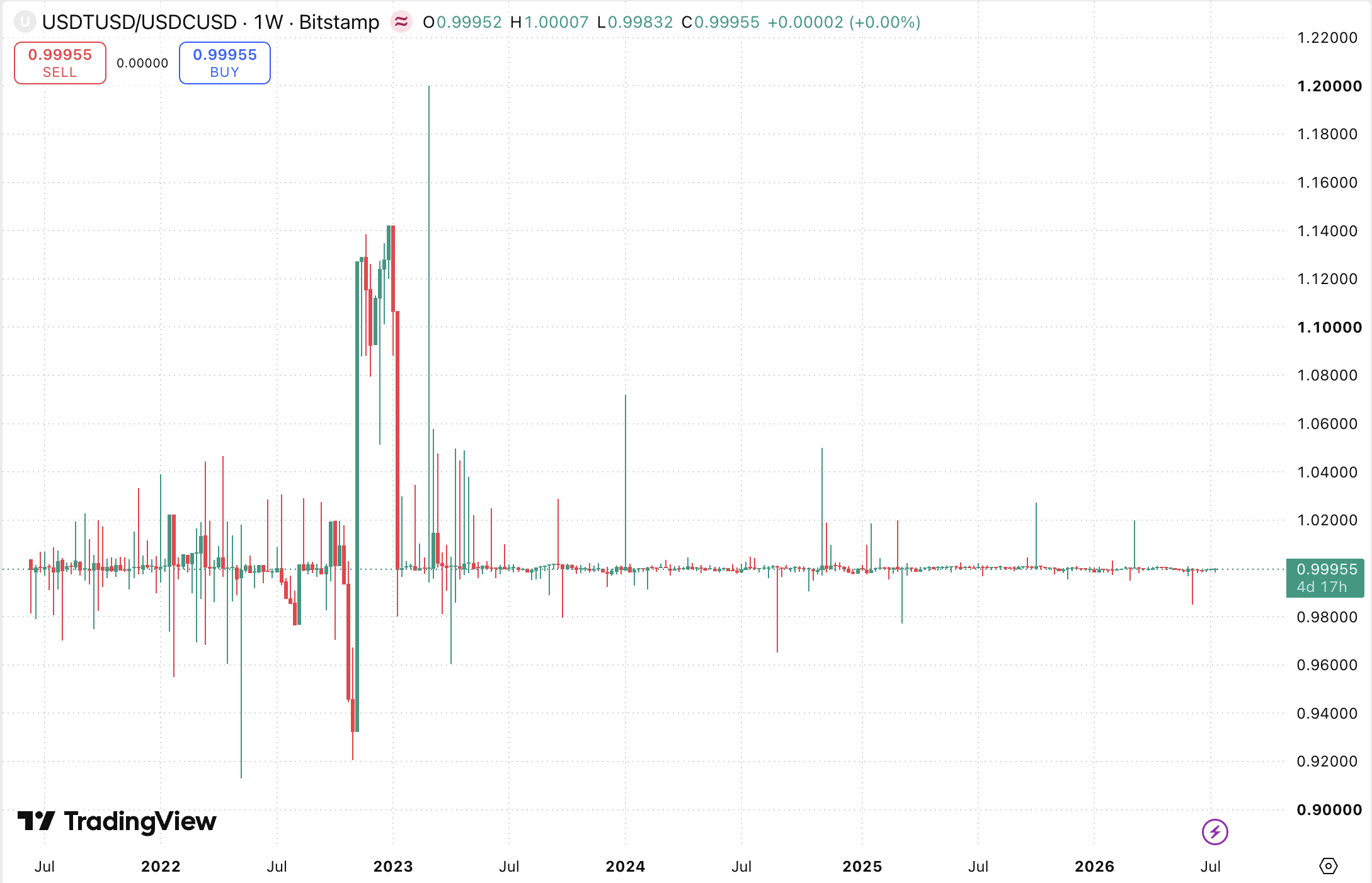
Figure 4.1: USDT/USDC Price Ratio
On the other hand, because LSDs accrue staking yield, the price ratio between an LSD and its underlying token should follow an upward-sloping line over time.
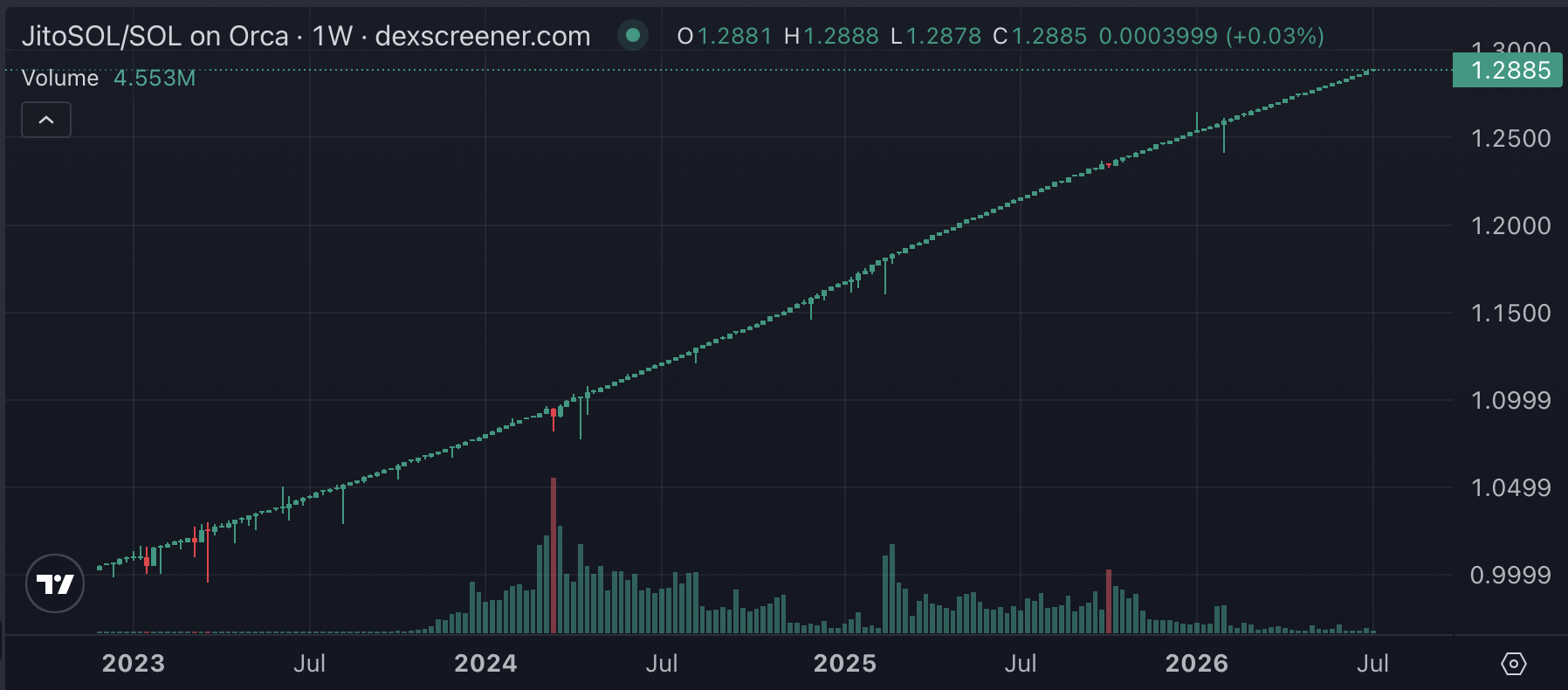
Figure 4.2: jitoSOL/SOL Price Ratio
However, stable pairs are not as safe as they might seem because of depeg risk. Depegging events are not uncommon and can be triggered by various factors, including liquidity conditions, market volatility, confidence and adoption, technological failures, supply and demand imbalances, human error, or crime.
The spike in Figure 4.1 reflects the USDC depeg in March 2023, when Silicon Valley Bank failed and Circle disclosed that $3.3 billion of reserves backing USDC were held there41. USDC fell as much as 13% below $1, and LPs in USDC-USDT pools saw their positions converted to USDC just as its value dropped. It was a heart-wrenching moment of disbelief, since USDC was widely believed to be the safest stablecoin.
USDC later repegged after the Federal Reserve said that it would support the bank’s creditors. UST, however, was not so lucky. Triggered by a bank-run-like sell-off on May 9, 2022, its design flaw accelerated the crash, and $18 billion of market cap evaporated within a week. If you were an LP in one of the UST-USDC or UST-USDT pools, chances are you suffered heavy losses.
These losses are not just bad luck–they are also a consequence of liquidity concentration in stable pairs. Because stable pairs have muted price volatility, it is often necessary to concentrate liquidity in super narrow ranges to earn meaningful fees. This works well until a depeg occurs, which can instantly convert all the good tokens into the collapsing one. Without active monitoring, LPs may end up holding the depegged token without knowing a depeg has happened. One way to manage this risk is through automation42: a bot can monitor the price and close the position once it deviates beyond a set threshold, withdrawing liquidity and selling the depegged token immediately.
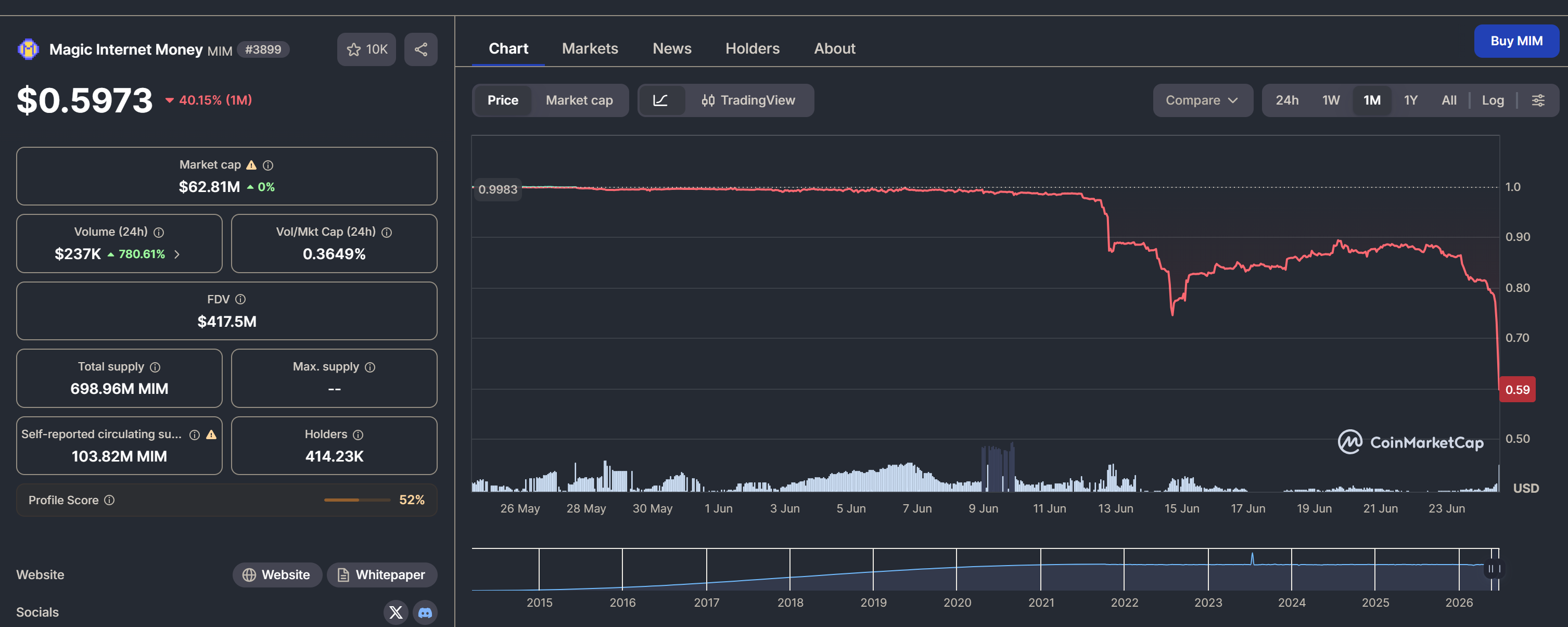
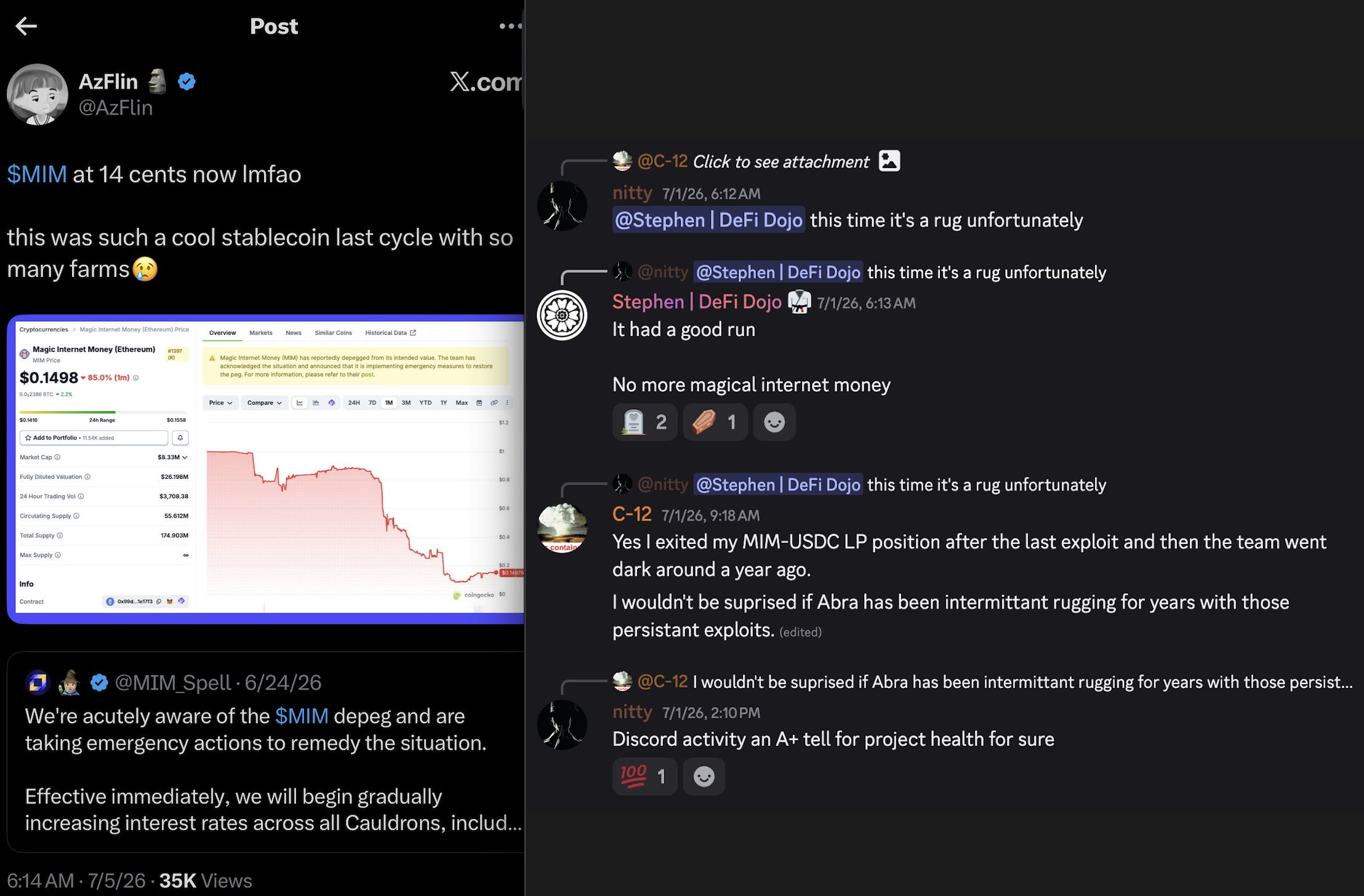
As I am finishing up this chapter, yet another “stable” coin, MIM, has depegged. MIM, or Magic Internet Money, was launched in June 2021 and quickly grew to over 1 billion dollars in market cap by October of that year. For a while it was one of the most talked‑about stablecoins in DeFi with many farms. Its latest depeg appears more like a deliberate rug pull43.
💡 LSD Depeg Events
It’s not just stablecoins that depeg; Liquid Staking Derivatives (LSDs) can also break away from their correct price. Try asking perplexity.ai the following questions:
- Give me a list of notable depeg events for ETH LSDs.
- What about SOL LSDs?
- How did these depeg events impact concentraded liquidity providers?
All the depeg events mentioned in this section, together with the case studies from the previous sections, reveal one undeniable fact: as an LP, you inherit the risks of the assets you provide liquidity for, whether those risks come from market structure, confidence shocks, technical failures, or something more deliberate. Once capital is deployed, the position can turn against you very quickly, and fees are usually far from enough to make up for it. Behind these cautionary case studies lie a common pattern of behavior that leads LPs to repeat the same mistakes, and the final section of the chapter summarizes lessons learned from those mistakes.
4.4 Zen of LP
This section is perhaps the most important part of the entire book.
Through case studies, I showed you most of the common ways of getting rekt when providing liquidity to AMM pools on a DEX. I hope it is now clear that LPing is not just about collecting fees, it is really about managing risk in an unforgiving environment. When the market turns, the wrong setup can quickly turn a promising position into a painful one. The ultimate question, then, is not how to chase the highest yield, but how to avoid the mistakes that make yield irrelevant in the first place.
These mistakes are:
Misjudge the long-term relative performance of a token pair and end up surrendering the stronger token for the weaker one.
Set liquidity ranges too narrow. The lure of immediate income is so strong that LPs cram liquidity into a narrow band to maximize fee capture. For a while this works. Then price falls through the lower boundary, fees stop, and the LP is left with depreciating assets.
Have a false sense of safety. DEXs do get hacked, teams do rug, and stable pairs do depeg.
From these mistakes, I extracted the major lessons, summarized in the poem below.
Zen of LP
Durable value is better than brief excitement.
Modest yield over time is better than fleeting excess.
Wide ranges are better than narrow ones.
Fees do not repair ruin.
Fees are not profit.
High APR does not last.
Do not chase yield without knowing what you may hold.
The stronger coin may not stay strong.
The weaker coin may never recover.
Stable pairs may not be safe.
Do not leave positions unattended.
BTC is safe.
USDC and USDT are usually safe.
Everything else may go to zero.
Activity is not edge.
Hope is not a strategy.
Automation is your friend.
DEX APRs are typically extrapolated from the past 24 hours of fees and rarely persist, as fee income depends on trading volume and time spent in range. Some platforms–especially ve(3,3)-style designs such as Solidly, Aerodrome, Velodrome, and Ramses–advertise APRs based on single-tick liquidity, i.e., extremely narrow ranges where positions quickly fall out of range. Therefore, these figures are misleading and should be ignored.↩︎
The perceived upside felt unusually compelling due to the parabolic price action, promotion by TechLead, and strong social reinforcement from MM’s Discord community.↩︎
The 2017–2018 alt season was the first crypto rotation where money left Bitcoin and went into altcoins. Characterized by the ICO boom, it was defined by extreme retail FOMO, rapidly falling Bitcoin dominance from 60% to 30%, and many small cap coins posting explosive (1,000% or more) gains in a short time and followed by a brutal collapse as the bubble burst and many tokens later lost most or all of their value.↩︎
ETH has had the second-largest market cap in crypto since January 2018.↩︎
WBTC is BTC tokenized as an ERC-20 (1:1 backed) for use on Ethereum and other Ethereum Virtual Machine (EVM) chains; it is not native BTC. WETH is ETH tokenized as an ERC-20 by locking ETH in a contract and minting WETH 1:1, which can be burned to redeem the original ETH.↩︎
ETHBTC = ETH price / BTC price↩︎
My entry was 0.06716941.↩︎
LayerZero is a cross-chain interoperability protocol that lets different blockchains communicate and transfer data or assets more directly.↩︎
STGETH = STG price / ETH price↩︎
The 1,570 USDC came from selling 2,537 STG in fees.↩︎
Wikipedia has a good entry on loss aversion.↩︎
A liquid staking derivative (LSD) is a token you receive when you stake crypto in a liquid staking protocol. It represents your staked position, accrues rewards, and can be used in other DeFi applications.↩︎
Tether had no exposure to SVB and traded above $1 as capital rotated out of USDC and other depegged stablecoins into USDT.↩︎
A good automation tool is Hummingbot: https://hummingbot.org/.↩︎
A rug pull is a scam where the team of a project suddenly withdraw support or drain liquidity, leaving investors stuck with tokens that are now worth little or nothing.↩︎
Welcome
Log in to access this book.